

Dover Port handles more freight traffic than any other UK port, making it a critical gateway for businesses importing and exporting goods to and from Europe. Whether you’re a first-time importer or an experienced trader, understanding the documentation requirements for customs clearance at Dover is essential for ensuring your goods move through the port smoothly and without costly delays.
At Martintrux, we’ve been managing customs clearance at Dover since 1982, processing thousands of declarations annually. Here’s everything you need to know about the documents required for successful customs clearance at Dover Port.
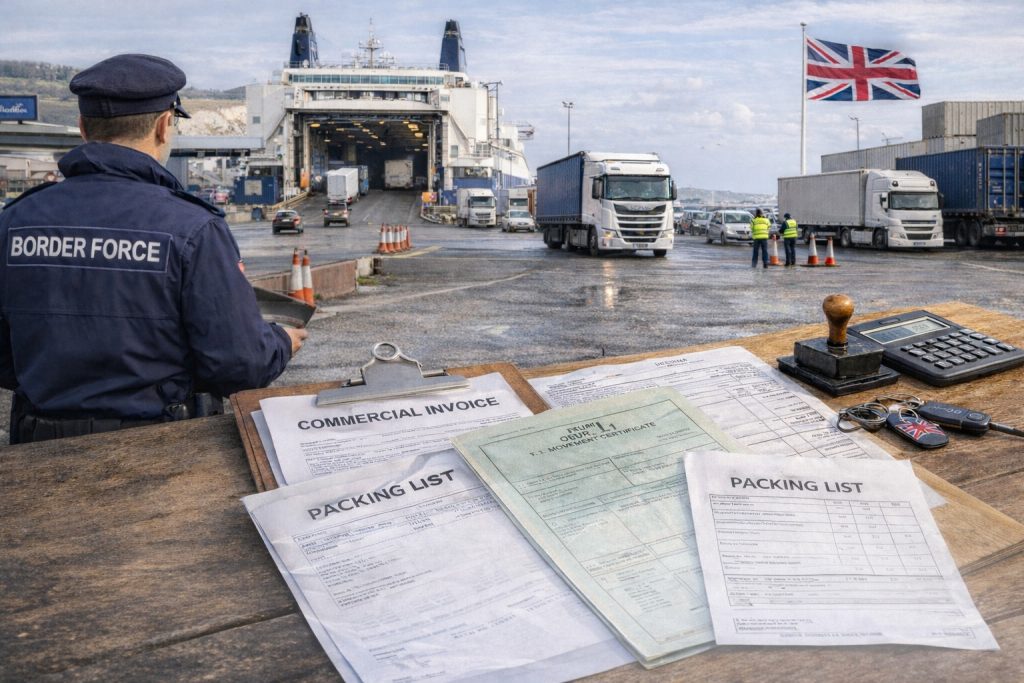
Essential Documents for Import Clearance at Dover
Commercial Invoice
The commercial invoice is the foundation of any customs declaration. This document must include:
- Complete details of the seller and buyer (including EORI numbers)
- Comprehensive description of the goods
- Quantity and unit of measurement
- Value of goods in the currency of sale
- Country of origin
- Terms of sale (Incoterms)
- Payment terms
The commercial invoice must be accurate and detailed, as customs officers use this information to determine the correct tariff classification, duty rates, and VAT liability.
Packing List
A detailed packing list specifies how goods are packed, including:
- Number of packages
- Type of packaging (pallets, boxes, etc.)
- Dimensions and weight of each package
- Marks and numbers on packages
- Detailed contents of each package
This document helps customs and border force officers verify that what’s declared matches what’s physically present.
CMR Consignment Note
Dover operates primarily as a roll-on/roll-off (Ro-Ro) port for accompanied and unaccompanied trailers crossing the Channel. For this road freight traffic, you’ll need the CMR (Convention Relative au Contrat de Transport International de Marchandises par Route) consignment note, which serves as:
- Receipt for the goods
- Evidence of the contract of carriage
- Proof of the condition of goods at collection
You’ll also need your ferry booking reference or trailer reference number. Note that Bills of Lading are typically used at container ports like Felixstowe or Southampton, not at Dover’s Ro-Ro operations.
Import Declaration (Customs Declaration)
The customs declaration itself is submitted electronically through the Customs Declaration Service (CDS). This requires:
- Your EORI (Economic Operator Registration and Identification) number
- Commodity codes for all goods
- Customs Procedure Code (CPC)
- Value for customs purposes
- Details of any preferences or reliefs being claimed
At Martintrux, we prepare and submit these declarations on behalf of our clients, ensuring accuracy and compliance with HMRC requirements.
Certificate of Origin (When Applicable)
If you’re claiming preferential duty rates under a trade agreement, you’ll need appropriate proof of origin:
For UK-EU Trade and Cooperation Agreement:
- Statement on origin on the commercial invoice (EUR.1 is not used for UK-EU trade)
For other trade agreements:
- EUR.1 movement certificate (used for some non-EU agreements)
- Certificate of origin from the country of export
- Other origin documentation as specified in the relevant agreement
Trade agreements with various countries offer reduced or zero-duty rates, but only with correct origin documentation.
Import Licences and Permits
Certain goods require specific licences or permits before they can be imported:
- Agri-food goods require pre-notification on IPAFFS (Import of Products, Animals, Food and Feed System) and relevant health documentation
- Endangered species require CITES permits
- Controlled goods need specific import licences
- Textiles from certain countries may require import authorisation
Failing to obtain necessary licences before arrival causes significant delays.
Additional Documentation for Specific Goods
Depending on what you’re importing, you may also need:
- Veterinary health certificates for animal products
- Phytosanitary certificates for plants and plant products
- Conformity certificates for regulated goods
- Analysis certificates for certain chemicals or foodstuffs
- Dangerous goods documentation for hazardous materials
Essential Documents for Export Clearance at Dover
Export Declaration
Like imports, exports require an electronic customs declaration submitted via CDS, including:
- EORI number
- Commodity codes
- Destination country
- Export procedure code
- Details of any export licences
Commercial Invoice and Packing List
The same detailed documentation required for imports applies to exports. Your buyer will need these documents for import clearance in the destination country.
Export Licences
Some goods require export licences, including:
- Military or dual-use goods
- Certain chemicals
- Cultural goods over specified values
- Goods subject to trade sanctions
Proof of Export
For certain relief schemes or VAT zero-rating, you need evidence that goods have physically left the UK.
T1 Documentation
When moving non-Union goods (goods that don’t have UK/EU customs status) through the EU under transit procedures, you’ll need T1 documentation. Martintrux operates a significant Transit Guarantee to enable exporters to move goods under T1 status efficiently.
Additional Requirements Post-Brexit
Since the UK’s departure from the EU, additional requirements include:
Safety and Security Declarations
Entry Summary Declarations (ENS) are required for imports from the EU into Great Britain, typically filed by the carrier. Exit Summary Declarations (EXS) may be required in certain scenarios depending on the movement and destination of goods.
Customs Intermediary Details
If you’re using a customs agent like Martintrux, their details must be included in declarations.
Deferment Account or Payment Method
You need a method to pay import duties and VAT, either through:
- Your own deferment account with HMRC
- Your customs agent’s deferment account
- Immediate payment arrangement
Martintrux holds our own deferment account to assist importers without their own facility.
Why Accurate Documentation Matters
Incomplete or incorrect documentation can result in:
- Goods being held at Dover, incurring storage charges
- Delays in delivery to your customers
- Penalties from HMRC for incorrect declarations
- Physical inspections that could have been avoided
- Damage to your AEO status if you hold one
Dover handles many thousands of lorries per day during peak periods. Any documentation issues create bottlenecks that affect not just your shipment but the entire supply chain.
How Martintrux Simplifies the Process
As an AEO-certified customs clearance specialist with over 40 years’ experience at Dover Port, Martintrux manages the entire documentation process for you:
- We prepare accurate declarations in advance of goods arriving
- We ensure all supporting documents are complete and compliant
- We submit declarations electronically for rapid processing
- We monitor clearances 24/7, year-round
- We resolve any queries with HMRC or Border Force immediately
Our objective is to secure release of your consignments in minimum time, leaving no room for subsequent challenge from any authority.
Get Expert Customs Clearance at Dover
Don’t let documentation requirements slow down your supply chain. With Martintrux managing your customs clearance, you benefit from our decades of experience, AEO accreditation, and commitment to accuracy and efficiency.
Whether you’re importing through Dover for the first time or looking for a more reliable customs clearance partner, we’re here to help.
Contact Martintrux today:
Our Dover office team will discuss your requirements and explain how we can streamline your customs clearance process, ensuring your goods move through the UK’s busiest port without delay.
Martintrux — Professional customs clearance management since 1982.