

When planning international shipments, one of the most fundamental questions is: “How many pallets will fit in my container?” The answer affects your shipping costs, logistics planning, and overall supply chain efficiency. However, it’s not as straightforward as you might think – the number of pallets that fit depends on container size, pallet type, loading method, and the characteristics of your cargo.
At Martintrux, with over 40 years of experience in freight forwarding and customs clearance, we help businesses optimise their container loads daily. Here’s everything you need to know about pallet capacity in shipping containers.
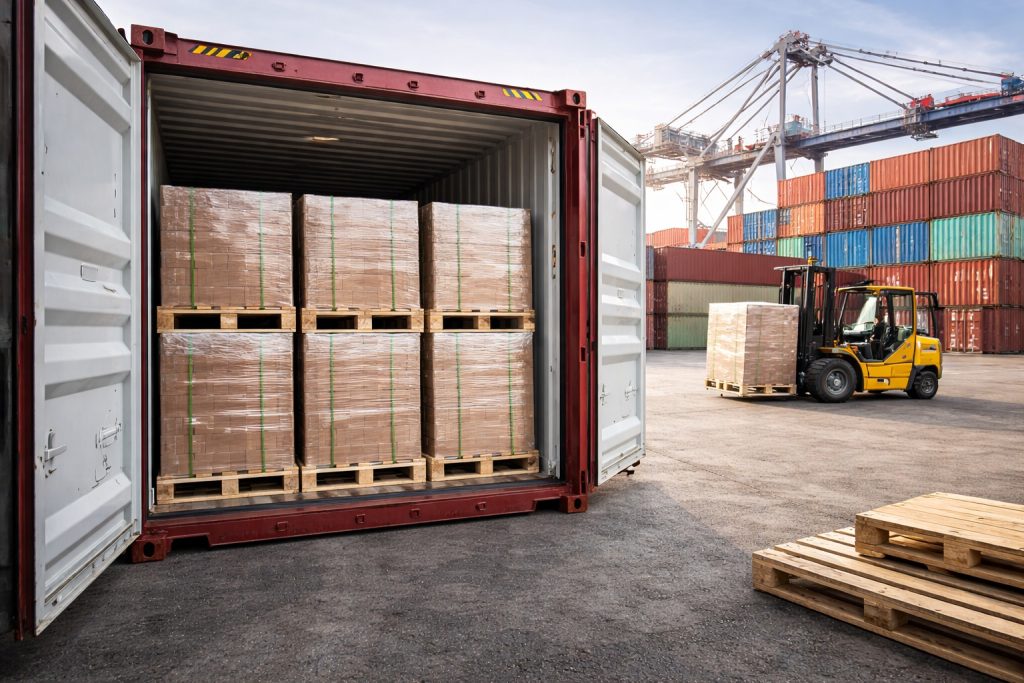
Standard Container Sizes and Pallet Capacities
20ft Standard Container
The most common smaller container option:
Internal dimensions (approximate):
- Length: 5.9m (19’4″)
- Width: 2.35m (7’8″)
- Height: 2.39m (7’10”)
Pallet capacity:
- Euro pallets (1200mm x 800mm): 11 pallets in a single layer
- UK standard pallets (1200mm x 1000mm): 9-10 pallets in a single layer
- US standard pallets (1200mm x 1016mm): 9-10 pallets in a single layer
40ft Standard Container
The most popular container size for international freight:
Internal dimensions (approximate):
- Length: 12.03m (39’6″)
- Width: 2.35m (7’8″)
- Height: 2.39m (7’10”)
Pallet capacity:
- Euro pallets: 25 pallets in a single layer
- UK standard pallets: 20-21 pallets in a single layer
- US standard pallets: 20-21 pallets in a single layer
40ft High Cube Container
Popular for voluminous cargo that doesn’t exceed weight limits:
Internal dimensions (approximate):
- Length: 12.03m (39’6″)
- Width: 2.35m (7’8″)
- Height: 2.69m (8’10”)
Pallet capacity:
- Same floor capacity as 40ft standard
- Euro pallets: 25 pallets per layer
- UK standard pallets: 20-21 pallets per layer
- The additional height allows for double-stacking suitable cargo
45ft High Cube Container
Less common but useful for maximum capacity:
Internal dimensions (approximate):
- Length: 13.56m (44’6″)
- Width: 2.35m (7’8″)
- Height: 2.69m (8’10”)
Pallet capacity:
- Euro pallets: 27-30 pallets per layer
- UK standard pallets: 24 pallets per layer
Understanding Different Pallet Types
The type of pallet significantly affects how many fit in a container:
Euro Pallet (EUR/EPAL)
- Dimensions: 1200mm x 800mm
- Most efficient for container loading
- Standard across Europe
- Fits 11 in a 20ft, 25 in a 40ft container
UK Standard Pallet
- Dimensions: 1200mm x 1000mm
- Common in UK domestic logistics
- Slightly less efficient in containers than Euro pallets
- Fits 9-10 in a 20ft, 20-21 in a 40ft container
US Standard Pallet (GMA)
- Dimensions: 1200mm x 1016mm (48″ x 40″)
- Similar loading efficiency to UK pallets
- Standard in North American trade
Custom or Oversized Pallets
Non-standard pallet sizes can significantly reduce container capacity and may require special loading arrangements.
Factors Affecting Actual Pallet Capacity
While the numbers above provide guidelines, several factors influence how many pallets you can actually fit:
1. Loading Method
Straight loading: Pallets loaded with the same orientation throughout. This is simpler but may not maximise space.
Turned loading (pinwheeling): Alternating pallet orientation to use space more efficiently. For example, in a 40ft container, you might load some Euro pallets lengthwise and some widthwise to fit 25 pallets rather than 24.
Mixed loading: Using different pallet sizes or combining palletised and non-palletised cargo requires careful planning.
2. Cargo Height and Stackability
Single-layer loading: When cargo cannot be stacked due to weight, fragility, or height, you’re limited to floor-level capacity.
Double-stacking: High cube containers allow stacking if your cargo permits, potentially doubling capacity for suitable goods.
Cargo overhang: If goods extend beyond pallet edges, this reduces how many pallets fit.
3. Weight Distribution
Container weight limits vary but typically:
- 20ft container: Maximum gross weight ~30,480kg (but check specific container rating)
- 40ft container: Maximum gross weight ~30,480kg
Heavy cargo may reach weight limits before filling the container volume. You must distribute weight evenly to prevent structural issues and ensure safe transport.
4. Door Width and Loading Access
Container door openings are slightly narrower than internal width:
- Standard door opening: approximately 2.34m wide
This sometimes affects how pallets can be maneuvered during loading, particularly with wider pallets.
5. Cargo Securing Requirements
You need space for:
- Dunnage (protective materials between cargo layers)
- Securing straps or bars
- Void fillers to prevent movement
- Possibly extra space if using load bars across the container
These reduce available space and may affect pallet count.
Maximising Your Container Load
Plan Pallet Configuration in Advance
Before booking, calculate exact pallet dimensions including any overhang and plan the optimal loading pattern. Use container loading software or work with your freight forwarder to maximise efficiency.
Consider Pallet Standardisation
Where possible, use standard Euro pallets for international shipping to Europe and UK. They’re designed for optimal container and vehicle loading.
Stack Strategically
If cargo permits stacking:
- Place heaviest pallets on the bottom layer
- Ensure weight distribution is even across the container floor
- Use appropriate packaging to protect lower-layer goods
- Consider interlock stacking patterns for stability
Use High Cube Containers for Light, Bulky Goods
If your cargo is voluminous but light (textiles, for example), high cube containers provide extra height without hitting weight limits.
Combine with Non-Palletised Cargo
Sometimes filling gaps around pallets with smaller boxes or non-palletised items maximises space usage.
Common Loading Configurations
40ft Container with Euro Pallets
Most common configuration: 25 pallets in a single layer
- Two rows of pallets lengthwise
- Some turned loading to optimise space
- Small gap at the end for securing
Double-stacked (if cargo permits): 50 pallets
- Requires high cube container and stackable goods
- Must respect weight limits
40ft Container with UK Standard Pallets
Typical configuration: 20-21 pallets
- Two rows lengthwise
- Tighter fit than Euro pallets
- Less flexibility in loading patterns
20ft Container Mixed Loading
For smaller shipments, optimising a 20ft container with 10-11 pallets plus loose cargo often provides the best value.
Weight Limits: The Hidden Constraint
Volume isn’t the only consideration. Maximum gross weight for most containers is around 30,480kg, including:
- Container tare weight (empty container): ~2,300kg for 20ft, ~3,700-4,000kg for 40ft
- Your cargo weight
- Pallet weight
- Securing materials
Example calculation for 40ft container:
- Maximum gross: 30,480kg
- Container tare: -3,800kg
- Available payload: 26,680kg
- If each loaded pallet weighs 500kg: maximum 53 pallets by weight
- But floor space limits you to ~25 pallets in a single layer
Dense, heavy goods reach weight limits well before filling the container volume.
Special Considerations for Different Cargo Types
Textiles and Garments
Martintrux specialises in textile logistics. These goods are typically:
- Light but voluminous
- Ideal for high cube containers
- Can often be double-stacked
- May use hanging methods rather than palletisation
Beers, Wines, and Spirits
Our dedicated beverage solutions handle:
- Heavy cargo that may reach weight limits quickly
- Requires careful weight distribution
- Needs secure stacking to prevent breakage
- Temperature-controlled containers may be necessary
General Merchandise
Varies widely – work with your freight forwarder to optimise based on specific cargo characteristics.
Working with Martintrux for Optimised Container Loading
At Martintrux, we help businesses make the most of every container:
Expert planning: We calculate optimal pallet configurations based on your cargo specifications
Customs clearance coordination: Our AEO-accredited customs clearance ensures smooth processing at Felixstowe, Southampton, and other UK container ports
Documentation management: We handle all required shipping and customs documentation
Supply chain optimisation: We advise on pallet standardisation and loading strategies to reduce costs
Warehousing solutions: Our warehousing facilities can consolidate shipments to maximise container utilisation
Specialist handling: Expertise in textiles, beverages, and diverse cargo types
Whether you’re importing through Felixstowe, Southampton, or other UK container ports, or exporting worldwide, our team ensures your cargo is loaded efficiently and clears customs smoothly.
The Bottom Line
Quick reference:
- 20ft container: 9-11 pallets (depending on pallet type)
- 40ft container: 20-25 pallets (depending on pallet type)
- 40ft high cube: same floor capacity, but allows double-stacking for suitable cargo
However, optimal loading depends on your specific cargo, pallet type, weight, and stackability. Professional advice ensures you maximise efficiency while maintaining cargo safety and compliance.
Need help planning your container shipment or customs clearance?
Contact Martintrux today:
Our experienced team will help you optimise your container loading, manage documentation, and ensure smooth customs clearance through all UK ports. With offices in Dover, Heathrow, and Manchester, and over 500 years of combined experience, we’re your trusted partner for international freight.
Martintrux — Expert freight forwarding and customs clearance since 1982.